

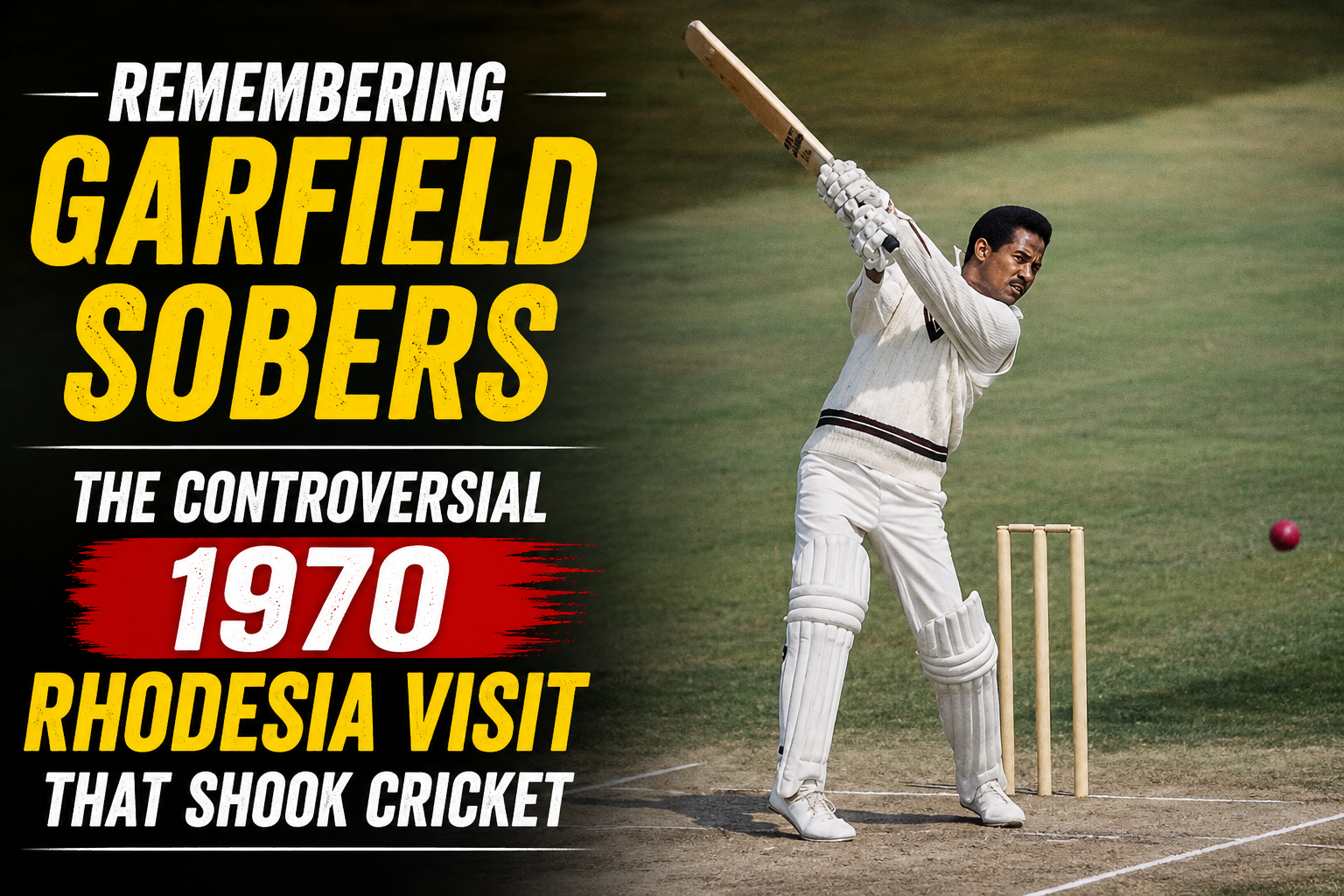
Garfield Sobers’ Controversial Rhodesia Visit: A Cricket Legend’s Most Debated Decision
The cricket world continues to remember Sir Garfield Sobers not only as one of the greatest all-rounders the game has ever produced but also for one of the most controversial episodes of his career—his visit to Rhodesia (now Zimbabwe) in 1970.
At a time when racial segregation and political tensions dominated southern Africa, Sobers’ decision to play in Rhodesia triggered global criticism and became one of the biggest talking points in international cricket.
A Visit That Sparked Worldwide Debate
In September 1970, Sobers travelled to Salisbury (present-day Harare) to participate in a double-wicket cricket tournament.
Rhodesia was then under white-minority rule, with the country caught in a bitter political conflict. Although cricket was not legally segregated as it was in apartheid South Africa, racial discrimination remained deeply rooted in society.
Sobers’ appearance drew criticism across the Caribbean and the wider cricketing world, with many questioning why one of the sport’s greatest Black icons had agreed to play in a country facing international condemnation.
Friendship Beyond Politics
One memorable story from the tournament involved former South Africa captain Ali Bacher, who partnered Sobers in the competition.
Bacher later recalled how Sobers laughed openly after watching one of his deliveries, creating a light-hearted moment during an otherwise politically sensitive visit.
The pair developed a close friendship through county cricket, highlighting how personal relationships often crossed political divides during that era.
Public Backlash Follows
The backlash after Sobers returned home was swift.
Political leaders, former players and members of the public criticised the West Indies captain for visiting Rhodesia. There were even calls for him to step down as captain, while concerns emerged that future international tours could be affected.
The controversy grew so large that Sobers eventually issued a public apology, admitting he had underestimated the political significance of the visit and stating that he would not have travelled had he fully understood the wider implications.
A Defining Chapter in Cricket History
Although the incident briefly overshadowed Sobers’ remarkable cricket career, it remains an important reminder of how closely sport and politics were intertwined during that period.
Years later, Sobers continued to enjoy warm relations with many former South African cricketers and played a symbolic role during the unification of South African cricket in the early 1990s, when the country’s sporting landscape began to change following the end of apartheid.
Sobers’ Legacy Lives On
Despite the controversy surrounding the Rhodesia visit, Garfield Sobers’ legacy as one of cricket’s greatest-ever players remains unquestioned.
His extraordinary achievements with both bat and ball transformed the game, while the events of 1970 continue to serve as an important chapter in cricket’s history, illustrating how sporting decisions can carry far-reaching political and social consequences.
- Subhadeep Ghosh Appointed India Fielding Coach Ahead of Sri Lanka Test Series
- Rajat Patidar to Lead Central Zone in Duleep Trophy 2026; Rinku Singh Named Vice-Captain
- KKR Captaincy Race Begins After Ajinkya Rahane Retirement; Rinku Singh Emerges as Front-Runner
- ICC Men’s ODI World Cup 2027 Venues Announced: South Africa, Zimbabwe and Namibia Ready to Host Cricket’s Biggest Event
- Bangladesh Appoint Litton Das as ODI Captain; Mehidy Hasan Miraz Relieved of Leadership Role